

C18 Silica Gel (Octadecyl Phase)
C18 silica gel is the most widely used reversed phase material because it is both popular and versatile. It creates strong hydrophobic interactions, which allow it to separate a wide variety of organic compounds effectively.
In practice, C18 silica gel is often chosen for separating nonpolar to moderately polar compounds. For example, it works well with fatty acids, glycerides, polycyclic aromatics, phthalate esters, fat-soluble vitamins, steroids, prostaglandins, and PTH amino acids. Therefore, it has become a standard choice in many chromatography applications.

Bonded Phases and Functionalized C18 Silica Gel
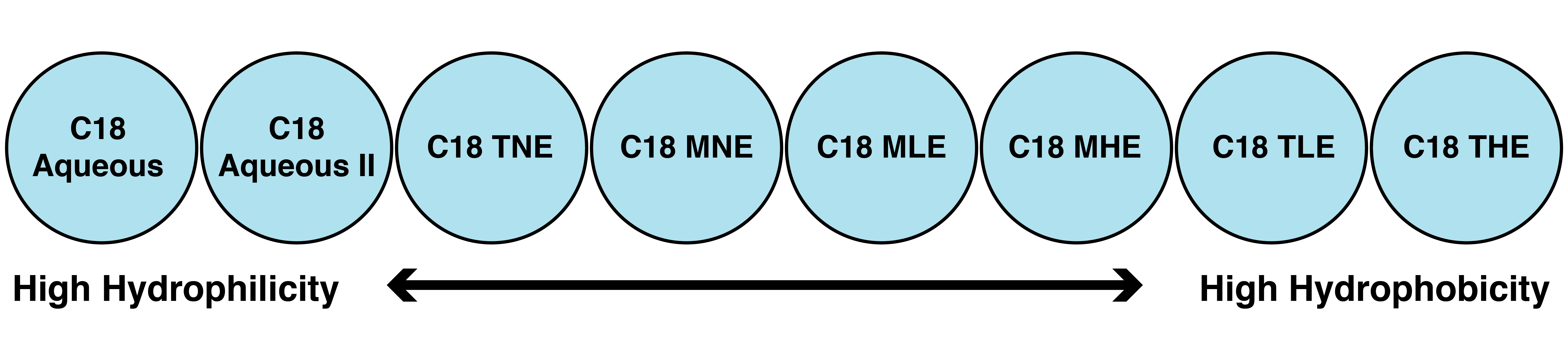
Sorbtech also offers C18 silica gel with a broad range of bonding chemistries. These options extend from high hydrophilicity, such as bimodal aqueous phases, to high hydrophobicity, such as trifunctional phases with advanced endcapping. As a result, you can select the exact C18 bonded phase that best matches your separation needs—whether you require higher retention for hydrophobic compounds or greater compatibility with aqueous mobile phases.
| Type | Functionality |
|---|---|
| C18 Aqueous | Mixed Mode |
| C18 Aqueous II | Mixed Mode |
| C18 MNE | Monofunctional Non Endcapped |
| C18 MLE | Monofunctional Low endcapped |
| C18 MHE | Monofunctional High endcapped |
| C18 TNE | Trifunctional Non Endcapped |
| C18 TLE | Trifunctional Low Endcapped |
| C18 THE | Trifunctional High Endcapped |