

Chiral Separation MCI GEL® HPLC Columns
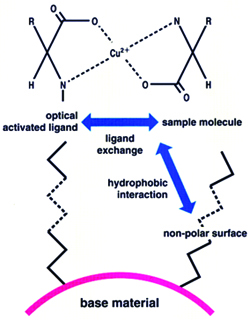
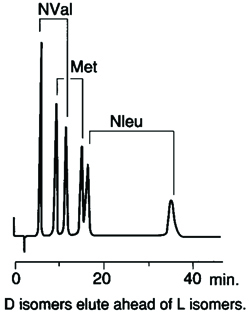
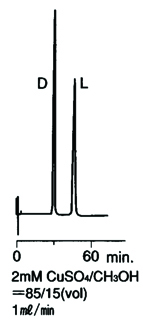
MCI GEL® CRS10W and its companion product MCI GEL® CRS15W (an optical isomer of CRS10W) are based on a 3 µm with 100 Å mean pore diameter of silica gel coated with N, N-Dioctyl -L(or D)-alanine which is a novel optical activated ligand. The chiral resolution mechanism is a combination of ligand exchange and hydrophobic interaction. A copper sulfate aqueous solution is used as an eluent. Elution samples are directly detected at a wave length of 254 nm because the complex compound, composed of the sample molecule and copper in the eulent, are the objects of detection. With the CRS10W, D-isomers generally elute in front of L-isomers while L-isomers elute ahead of D-isomers on the CRS15W. The hydrophobic interaction mechanism allows hydrophilic samples to elute faster than hydrophobic molecules. Long alkyl chain or aromatic compounds will elute late or require an organic solvent (CH3CN or CH3OH, max. of 15 v/v%) to prevent absorption onto the stationary phase.
Separation Performance:
- The CRS series columns separate over 20 D,L-α-Amino acids by only single column. The columns separate not only α-Amino acids but also α-Hydroxy carboxylic acids and derivative amino acids such as Acetylated amino acids.
- The columns provide excellent resolution operated at room temperature.
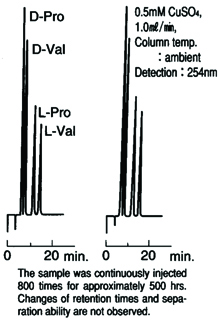
- The columns show high durability.
ProtEx series are for ion exchange for sample proteins.