


Syringe filters are small, cylindrical devices designed to clean liquids or gases before they are pushed through a syringe. In laboratories, they remove impurities from samples. In medical settings, they help sterilize liquids before injection. Because they are simple and reliable, syringe filters have become an essential tool across many industries.
Common Types of Syringe Filters
-
Cellulose acetate filters – Best for aqueous solutions. They offer fast flow rates and low protein binding.
-
Polypropylene filters – Strong against harsh chemicals and can handle higher temperatures.
-
Nylon filters – Ideal for organic solvents. They provide excellent chemical resistance.
Key Applications
Syringe filters support a wide range of work:
-
Biotechnology – Purifying proteins and biomolecules.
-
Pharmaceuticals – Filtering and sterilizing injectable drugs.
-
Clinical research – Cleaning and sterilizing samples before analysis.
Final Thoughts
Syringe filters may be small, but they play a big role. By ensuring samples and solutions are clean and safe, they improve the reliability of results and support better outcomes in both research and medical use.
CHROMAFIL® Syringe Filters
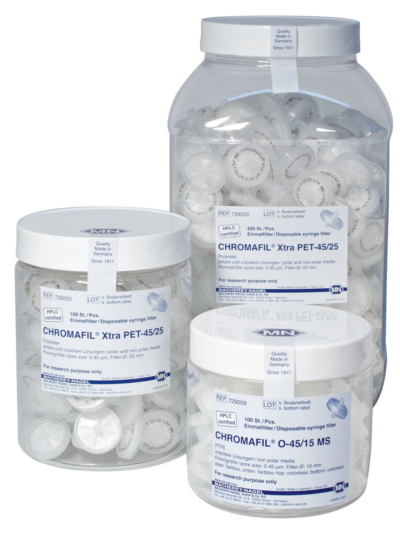
CHROMAFIL syringe filters are engineered for reliable performance across a wide range of filtration applications. Their design ensures clean, consistent results while maintaining compatibility with both manual and automated systems such as SOTAX® dissolution systems.
Key Features
-
Membrane Options – Multiple membrane types to support diverse filtration needs.
-
Leak-Free Housing – Ultrasonically welded polypropylene shells, with no glue or extractable components.
-
Fast Flow Geometry – Reduces back pressure and improves efficiency.
-
Low Hold-Up Volume – Maximizes sample recovery with ~120 µL (25 mm Ø), 12 µL (15 mm Ø), and 5 µL (3 mm Ø).
-
Certified Clean – Suitable for HPLC and UPLC analysis.
-
Universal Connectivity – Standard Luer-Lok™ inlet and Luer slip outlet for secure connections.
Housing and Safety Advantages
-
Polypropylene Housing – Provides superior solvent stability compared to acrylate or polystyrene.
-
Bidirectional Filtration – Prevents liquid from bypassing membranes.
-
Luer-Lok Inlet – Ensures a secure, pressure-resistant connection on the high-pressure side.
-
Deflector Design – Breaks the liquid stream before it hits the membrane, preventing rupture.
Optimized Flow Distribution
-
Star-Shaped Distributor – Evenly spreads liquid across the membrane surface, increasing utilization and maintaining high flow efficiency.
-
Color Coding – Filters with 0.2 µm pores feature a yellow shell, while 0.45 µm pores remain colorless. Each membrane type is further distinguished by unique colors for easy identification.

About the Author – Randy Cooper, MBA PCM
Randy Cooper brings more than 35 years of experience in marketing technology. He earned his Bachelor of Science in Information Technology with a concentration in web development from the University of Phoenix and later completed his MBA in Digital Marketing at Liberty University. In addition, he holds the Professional Certified Marketer (PCM) credential from the American Marketing Association.
In 2009, Randy launched Buzz My Biz, a technology consulting agency dedicated to delivering enterprise-level solutions to small and mid-sized businesses. Since then, he has helped organizations grow by combining digital strategy, marketing expertise, and technical innovation.
When he steps away from the keyboard, Randy enjoys cheering on the Atlanta Braves, spending time outdoors hiking, and working in his yard.