


Core-Shell Phases : Maximum Efficiency for All HPLC Systems
Over the past several years, manufacturers of HPLC columns and instruments have worked to deliver higher separation efficiency while also reducing analysis times and increasing sample throughput. Core-shell phases technology now meets this demand by offering high resolution and faster runs at moderate pressures.
Particle Size vs. Pressure
Reducing particle size in fully porous silica to sub-2 µm can significantly shorten analysis time. However, it also pushes backpressure as high as 1000 bar, forcing labs to invest in costly ultra-high-pressure LC systems. Monolithic phases, by contrast, allow faster runs on conventional instruments with lower pressure, but they cannot match the separation efficiency of sub-2 µm particles.
Why Optimization Was Needed
Even with these advances, HPLC users still needed higher efficiency. That meant improving both resolution and speed while avoiding extreme pressure requirements.
Optimizing HPLC Particles
To achieve better performance, columns must deliver higher plate numbers (N). In practice, this means reducing plate height (h) while maintaining high linear velocity (u). This balance is the key to increasing resolution and shortening run times without exceeding pressure limits.
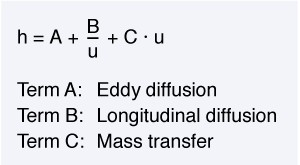
Flow Rate, Resolution, and the van Deemter Equation
According to the van Deemter equation, plate height (h) decreases until it reaches a minimum, which represents the maximum plate number. Beyond this point, plate height increases again as linear velocity (u) continues to rise. In practice, with 5 µm and 3 µm particles, higher flow rates can shorten analysis times, but they also reduce resolution.
Sub-2 µm Particles: High Efficiency, High Pressure
Sub-2 µm particles achieve lower plate heights at higher flow rates because both the A and C terms of the van Deemter equation depend on particle diameter. Smaller particles improve resolution, but they also generate extreme back pressures, sometimes reaching 1000 bar. These pressures demand ultra-high-performance LC systems, which many labs cannot accommodate.
Monolithic Columns: Speed with Tradeoffs
Monolithic silica columns offer an alternative. They can achieve very high linear velocities at much lower pressures, often around 100 bar. However, their plate heights are comparable only to 3 µm porous silica particles, and their loading capacity is more limited.
Core-Shell Technology: Balancing the Equation
The real challenge is balancing high flow rates, moderate pressures, and strong resolution. Core-shell technology solves this by using silica particles that are not fully porous. This design combines the speed advantages of sub-2 µm particles with pressure requirements closer to standard HPLC systems, creating a practical solution for most laboratories.