


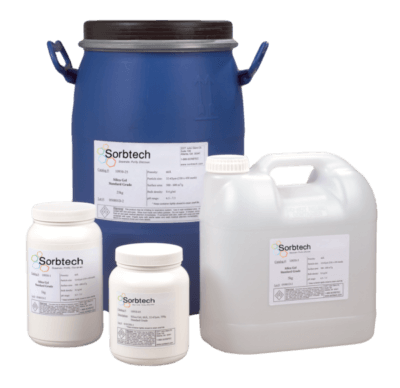
 Most chromatographers learn early that silica gel is the workhorse of normal-phase chromatography. It separates compounds based on polarity, provides excellent efficiency, and remains one of the most reliable purification media available.
Yet there’s a misconception that even experienced chemists sometimes carry with them:
Silica gel is often treated as an inert support when, in reality, it behaves more like a chemical reagent that happens to be packed into a column.
Understanding silica as a chemically active surface rather than a passive stationary phase can explain many of the strange results chemists encounter during purification.
The Surface Is Far More Complex Than It Looks
At first glance, silica gel appears simple. It is composed primarily of silicon dioxide and possesses an enormous surface area, often hundreds of square meters per gram.
However, the true personality of silica lies in its surface chemistry.
The surface is covered with silanol groups (Si-OH), creating a landscape filled with hydrogen-bonding sites, weakly acidic regions, and adsorption points. Every molecule moving through a silica bed must interact with this environment.
As compounds travel down the column, they are not merely partitioning between solvent and stationary phase. Instead, they are continuously forming and breaking thousands of molecular interactions with the silica surface.
This process happens so rapidly that we perceive it as chromatographic retention. In reality, it is a dynamic molecular conversation.
Why Two “Identical” Columns Can Behave Differently
Many chromatographers have experienced a puzzling situation:
A separation works beautifully on one column but behaves differently on another seemingly identical column.
Often, the culprit is not particle size, solvent composition, or flow rate. It is the silica surface itself.
Factors such as:
- Moisture content
- Surface activity
- Pore structure
- Metal impurities
- Prior storage conditions
can subtly alter how compounds interact with the stationary phase.
Silica is highly sensitive to water. Even trace amounts of adsorbed moisture can dramatically change retention behavior, especially for polar analytes.
This explains why a method developed in July might not perform exactly the same way in January, even when the experimental conditions appear unchanged.
When Silica Becomes a Reaction Vessel
Perhaps the most surprising aspect of silica gel is that it can actively promote chemical transformations.
Many organic chemists have discovered this accidentally.
Acid-sensitive compounds can decompose during purification. Protecting groups may partially cleave. Certain rearrangements can occur on-column. Some compounds emerge as different isomeric mixtures than when they were loaded.
In these situations, silica is no longer functioning solely as a stationary phase.
It is participating.
The weak acidity of silanol groups is often sufficient to influence sensitive molecules during prolonged contact times. For robust compounds, this effect may be negligible. For delicate compounds, however, the purification process itself can alter the sample.
The column becomes both purification tool and reaction environment.
The Case of the Missing Compound
One of the most frustrating experiences in purification occurs when NMR suggests a product is present, yet recovery remains unexpectedly poor.
Often, the answer is not decomposition.
The compound may simply be unwilling to leave the silica surface.
Highly polar compounds can bind so strongly through hydrogen bonding and dipole interactions that conventional eluents struggle to dislodge them.
In these cases, chemists often observe:
- Strong tailing
- Broad fractions
- Reduced recovery
- Apparent mass balance losses
Sometimes a small solvent modification, such as adding methanol, ammonia, acetic acid, or another modifier, changes everything.
The compound was never lost. It was merely having a stronger conversation with the silica than expected.
Why Silica Still Dominates After Decades
Given its quirks, one might wonder why silica remains the dominant stationary phase in flash chromatography and numerous preparative applications.
The answer lies in precisely the characteristics that sometimes create challenges.
Silica’s active surface provides:
- High selectivity
- Predictable retention patterns
- Broad applicability
- Excellent loading capacity
- Cost-effective purification
If silica were truly inert, many difficult separations would become significantly harder.
The same interactions that occasionally cause tailing or recovery issues are often the very interactions that allow closely related compounds to separate cleanly.
In other words, silica’s imperfections are part of its strength.
Thinking Beyond the Particle
Experienced chromatographers often focus on particle size, pore size, solvent systems, and gradient design.
Those factors certainly matter.
However, some of the biggest improvements in purification performance occur when chemists begin thinking about silica as a chemically active material rather than a simple packing medium.
When a compound behaves unexpectedly, it is worth asking:
- Is the silica interacting too strongly?
- Has moisture altered the surface activity?
- Could silanol interactions be affecting selectivity?
- Is the compound stable under mildly acidic conditions?
- Would a modifier improve recovery?
These questions often reveal the answer more quickly than changing solvent ratios alone.
Final Thoughts
Silica gel has earned its reputation as the industry’s most trusted purification medium. Yet its value extends far beyond serving as a stationary phase.
Every silica particle contains a chemically active surface capable of influencing retention, selectivity, recovery, and sometimes even molecular structure itself.
The next time a separation surprises you, remember: the silica is probably not just holding your sample.
It’s participating in the experiment.