


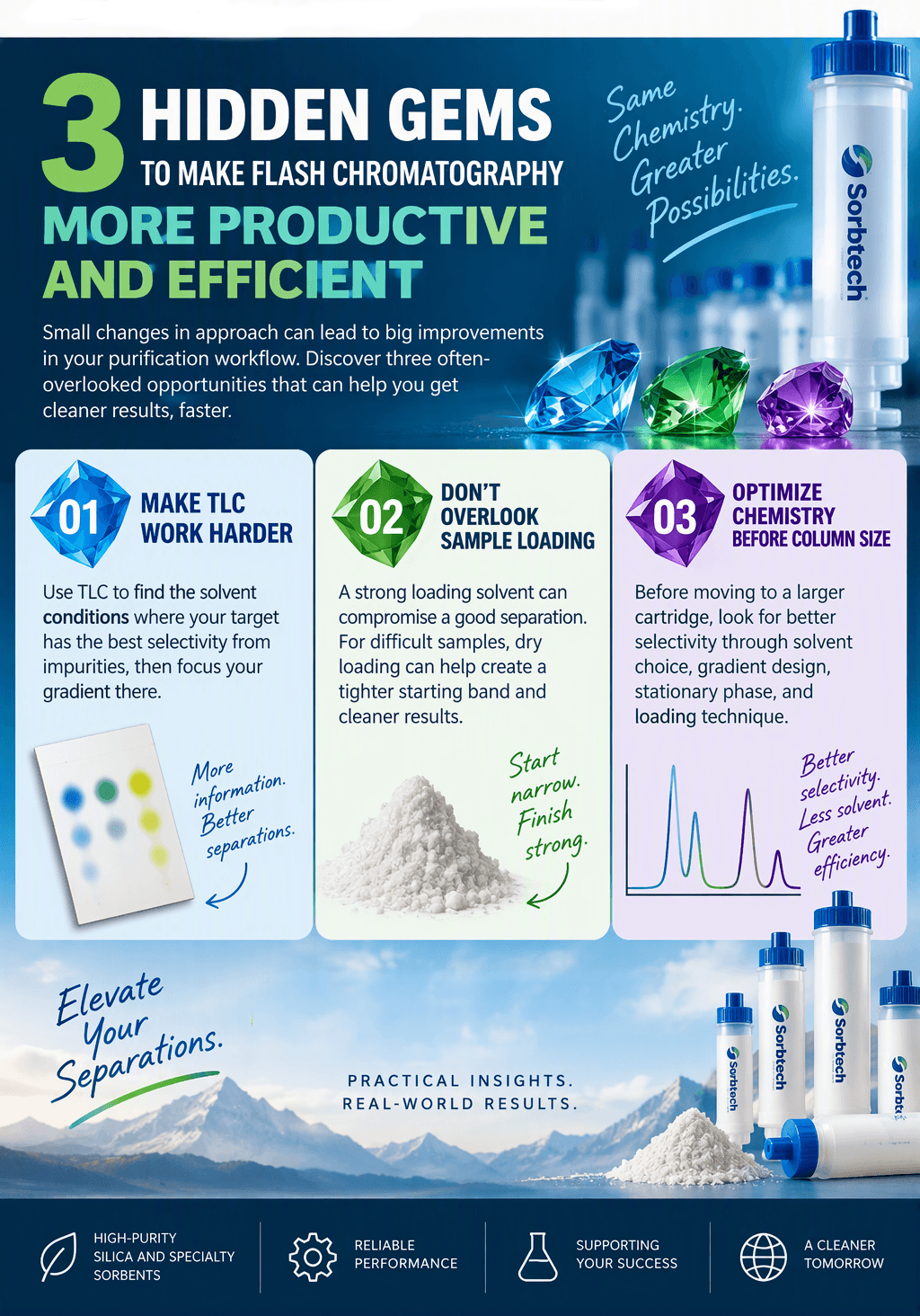
 Flash chromatography is the workhorse of the synthetic lab, yet it often consumes far more time, solvent, and silica than necessary.
When a separation fails or runs too long, troubleshooting usually centers on the obvious variables: cartridge size, flow rate, and solvent gradient. Although each matters, the largest productivity gains are typically determined before you press “Start.”
By focusing on the three fundamentals below, you can improve resolution, reduce solvent consumption, and shorten downstream evaporation time.
1. Turn TLC into a Method-Development Engine—not Just a Reaction Check
TLC is often relegated to answering a binary question: “Is the starting material gone?”
In practice, a well-run TLC plate is a quantitative blueprint for an optimized flash method. Modern automated flash systems use TLC retention data to calculate gradients, cartridge requirements, and maximum loading mass. Even so, many chemists still default to a generic 0–100% ethyl acetate-in-hexanes linear gradient over 20 minutes.
Focus on , not just
Two compounds can separate visibly near the solvent front ( vs. ), but because retention in column chromatography is inversely proportional to :
- At and , their retention volumes are and —a razor-thin difference of just . They will co-elute on a column.
- If you tune the mobile phase to drop those compounds down to and , their retention volumes become and —giving you a massive window of .
Why It Matters
When loading capacity skyrockets, allowing you to run a much smaller column. Once you identify that optimal solvent window on TLC, design a focused step gradient:
- Flush the non-polar impurities rapidly at low solvent strength.
- Step or flatten the gradient precisely across the target window.
- Ramp quickly to wash the column.
Takeaway: Don’t just ask, “What solvent moves my compound?” Ask, “What solvent ratio maximizes separation between my target and its nearest impurity?”
2. Treat Sample Loading as the Decisive Separation Step
Few chromatography errors are as common—or as damaging—as poor sample introduction.
You optimize the TLC, pick high-surface-area spherical silica, and build a tailored gradient. Then, you dissolve your crude sample in a generous volume of dichloromethane (DCM) or methanol because it dissolves quickly, and inject it onto a normal-phase cartridge running hexanes/ethyl acetate.
The Result: Solvent Breakthrough
- The strong dissolution solvent acts as a localized mobile phase front.
- It carries a portion of the sample straight down the column before any partitioning can occur.
- Bands broaden, peaks front or split, and resolution is lost within the first few inches of silica.
The Golden Rule: Start Narrow to Finish Narrow
- If liquid loading: The dissolution solvent should be chemically weaker than or identical to the initial mobile phase. If a stronger solvent is mandatory, keep the injection volume under of the total cartridge column volume.
- When in doubt, dry load (solid load): If your crude material requires a strong solvent (e.g., DCM, THF, DMF) to dissolve, adsorb it onto an inert matrix (Celite, Florisil, or loose silica) at a to mass ratio. Strip the solvent completely under vacuum until you have a free-flowing powder, then pack it into a dry-loading cartridge.
Dry loading eliminates the strong-solvent effect, helping the sample enter the stationary phase as a tight, concentrated band.
Takeaway: If a separation underperforms relative to TLC, don’t blame the cartridge first. Examine how the sample entered the stationary phase.
3. Exploit Selectivity Before Paying for Efficiency
When a separation fails, the default instinct is often: “We need a bigger column.”
Sometimes a larger cartridge is necessary to handle mass overload. But if the issue is poor resolution, upsizing the stationary phase (plate count) is the least efficient lever you can pull:
Resolution relationship: Rs = (√N/4) × ((α − 1)/α) × (k′/(1 + k′))
Because resolution scales with the square root of column length or plate count (√N), doubling cartridge size yields only about a 40% gain in resolution—while approximately doubling solvent consumption, run time, and the downstream evaporation burden.
By contrast, altering selectivity () delivers an exponential improvement in resolution without increasing cartridge size.
Build Selectivity Before Scaling Hardware
- Switch solvent families: If a Hexane/Ethyl Acetate system gives poor separation, tweaking the ratio from 3:1 to 4:1 rarely solves the problem. Pivot across the solvent selectivity triangle:
- Try a dipolar, aprotic pairing: Dichloromethane / Acetone
- Try an aromatic modifier: Toluene / Ethyl Acetate or Hexane / Diethyl Ether
- Change the stationary phase: If standard unbonded silica fails to separate closely eluting diastereomers or polar amines, test a diol-, cyano-, or amine-functionalized phase to alter secondary hydrogen-bonding interactions.
- Control the ionization state: For basic compounds streaking on silica, a volatile additive (e.g., ) often tightens tailing bands instantly by blocking acidic silanol sites.
Takeaway: Optimize chemistry first and scale hardware second. A smaller cartridge with strong selectivity can outperform a larger cartridge with poor selectivity.
The Holistic View: Optimize the Run for the Evaporator, Not Just the UV Trace
The fastest flash run is not necessarily the most efficient purification workflow.
Saving five minutes during chromatography means little if broad bands produce 18 test tubes of high-boiling solvent that require another 45 minutes to analyze and evaporate.
A high-selectivity, dry-loaded method on a compact cartridge can concentrate the target into two or three fractions, reduce solvent waste, and accelerate product isolation.
Pre-Run Checklist
Before you press Start on your next purification, pause and verify:
- Retention: Did my TLC maximize or did it merely confirm that the compound moves?
- Introduction: Is my loading solvent stronger than my starting gradient? Should this be dry-loaded?
- Selectivity: Am I using a larger column to brute-force a separation that a different solvent pair could solve instantly?
Answering these questions deliberately transforms flash chromatography from a recurring bottleneck into a predictable, engineered purification process.