


What Is C18 Needed for Reverse-Phase Chromatography?
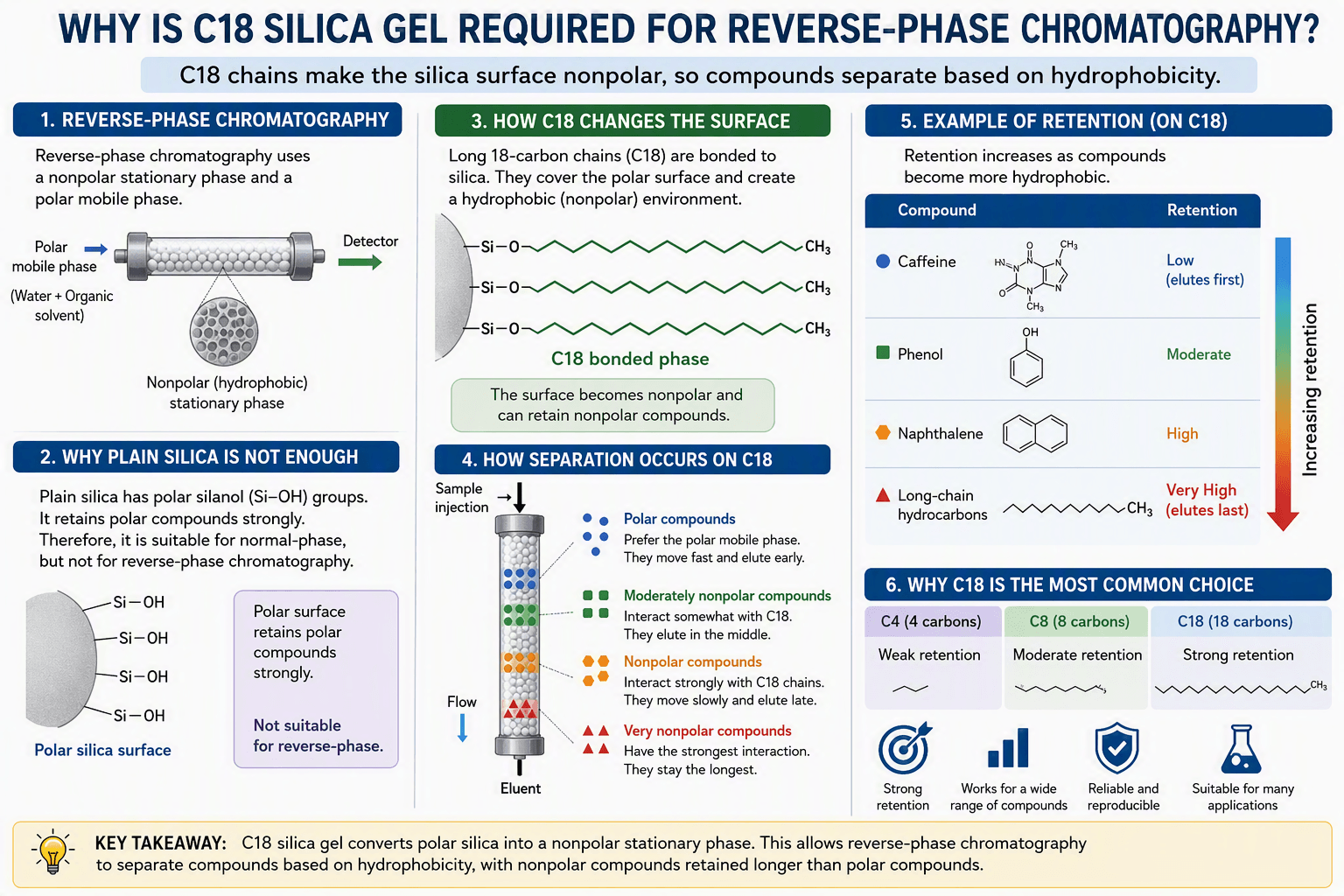
Reverse-phase chromatography separates compounds based on their hydrophobicity, or how strongly they avoid water.
In this technique:
- The stationary phase is nonpolar.
- The mobile phase is polar, usually water mixed with methanol or acetonitrile.
As the sample moves through the column, nonpolar compounds interact more strongly with the stationary phase. Therefore, they stay in the column longer than polar compounds.
Why Plain Silica Is Not Enough
Silica gel naturally contains many silanol (Si-OH) groups on its surface.
Because these groups are polar, they attract polar compounds. As a result, bare silica works well for normal-phase chromatography, where a polar stationary phase is needed.
However, reverse-phase chromatography requires the opposite type of surface. Therefore, silica must be modified before it can function as a reverse-phase packing material.
How C18 Changes the Silica Surface
Manufacturers bond long 18-carbon hydrocarbon chains to the silica surface.
Silica-O-Si-(CH2)17CH3
These carbon chains cover much of the polar silica surface and create a highly nonpolar environment.
As a result, the stationary phase becomes hydrophobic and can retain nonpolar compounds.
How Separation Occurs on a C18 Column
When a sample enters a C18 column:
- Polar compounds remain in the mobile phase and move through the column quickly.
- Nonpolar compounds interact with the C18 chains and move more slowly.
- Highly hydrophobic compounds show the strongest retention.
Therefore, compounds separate according to their hydrophobic character.
Example of Retention
A typical retention order on a C18 column is:
- Caffeine
- Phenol
- Naphthalene
- Long-chain hydrocarbons
In general, retention increases as a compound becomes more hydrophobic.
Why C18 Is So Common
Several bonded phases are available, including C4, C8, and C18. However, C18 offers a useful balance between retention and versatility.
Compared with shorter alkyl chains:
- C4 provides weaker retention.
- C8 provides moderate retention.
- C18 provides stronger retention for many compounds.
Because of this balance, C18 columns work well for a wide range of applications, including pharmaceutical, environmental, food, and biotechnology analyses.
Key Benefit of C18 Silica
The main purpose of C18 silica is to transform polar silica into a nonpolar stationary phase. Consequently, reverse-phase chromatography can separate compounds based on hydrophobicity. In addition, C18 provides strong retention, reliable performance, and broad method flexibility, making it the most widely used stationary phase in HPLC.