


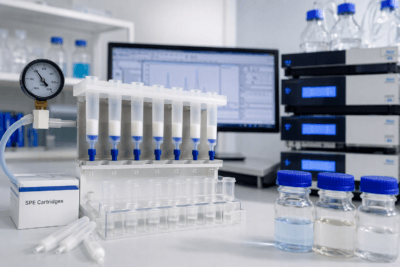
 Best Uses for SPE in Chromatography
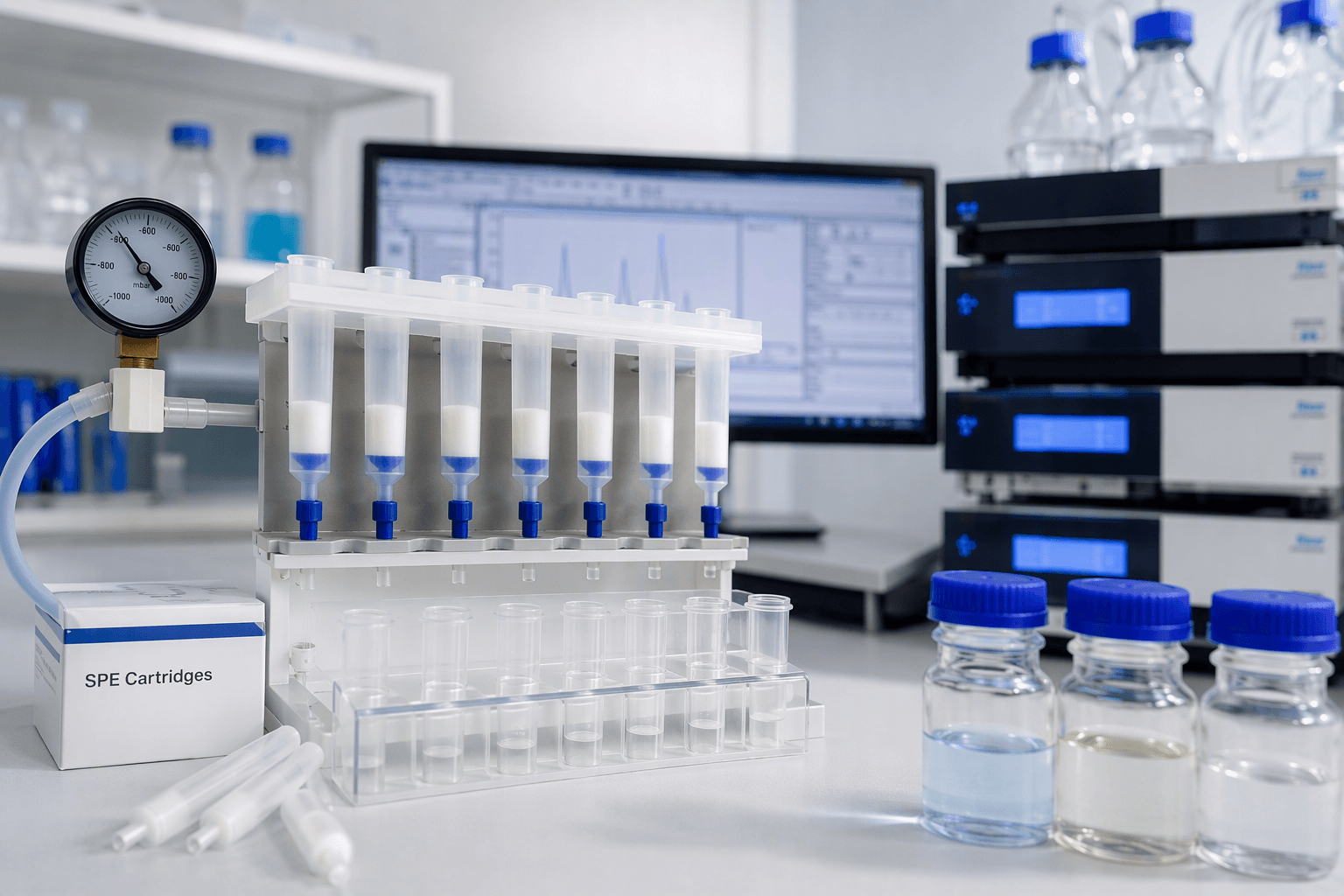
Solid Phase Extraction (SPE) is most often used to prepare samples before HPLC, UHPLC, GC, or LC-MS analysis. It helps remove unwanted compounds, concentrate target compounds, and improve data quality.
1. Sample Cleanup
First, SPE removes substances that can interfere with analysis while keeping the compounds of interest.
Common examples include:
- Pesticides in fruits and vegetables
- Drug residues in blood or urine
- PFAS in water samples
- Mycotoxins in food products
As a result, chromatograms are cleaner and easier to interpret.
2. Concentrating Trace Compounds
In addition, SPE can concentrate very small amounts of a compound from a large sample volume.
Examples include:
- Environmental pollutants in groundwater
- Pharmaceutical residues in drinking water
- Trace impurities in chemical products
Because the analytes are concentrated into a smaller volume, detection becomes easier and more sensitive.
3. Matrix Removal for LC-MS
LC-MS instruments are highly sensitive to sample contaminants such as salts, proteins, and lipids. Therefore, SPE is often used to remove these materials before analysis.
Common applications include:
- Clinical testing
- Drug monitoring
- Biomarker studies
- Proteomics research
Consequently, instrument performance improves and measurement accuracy increases.
4. Desalting Samples
SPE is also widely used to remove salts and buffer components that can affect chromatography and mass spectrometry results.
Typical applications include:
- Peptide purification
- Oligonucleotide analysis
- Protein research
As a result, analysts obtain better signals and more reliable data.
5. Separating Compound Classes
Furthermore, SPE can separate groups of compounds based on their chemical properties.
Examples include:
- Acidic compounds
- Basic compounds
- Neutral compounds
- Lipids and phospholipids
This step simplifies complex samples and makes later analysis more effective.
SPE Applications by Industry
| Industry | Common SPE Applications |
|---|---|
| Pharmaceutical | Drug testing, impurity analysis, bioanalysis |
| Environmental | PFAS, pesticides, herbicides, water contaminants |
| Food & Beverage | Mycotoxins, preservatives, pesticide residues |
| Clinical | Drug monitoring, biomarker analysis |
| Forensic | Drugs of abuse, toxicology testing |
| Cannabis | Cannabinoid and terpene analysis |
| Chemical Manufacturing | Product quality and impurity testing |
Common SPE Sorbents
| Sorbent | Best For |
|---|---|
| C18 | Nonpolar compounds, pharmaceuticals, pesticides |
| C8 | Moderately nonpolar compounds |
| Silica | Normal-phase applications |
| Amino (NH₂) | Sugars and polar compounds |
| SAX / SCX | Anion and cation exchange |
| WAX / WCX | Weak ion-exchange applications |
| Polymeric Sorbents | Broad-range sample cleanup |
| Carbon | Pigments and highly polar compounds |
Why SPE Is Popular
Compared with liquid-liquid extraction (LLE), SPE offers several advantages:
- Uses less solvent
- Requires less sample handling
- Produces more consistent results
- Is easier to automate
- Provides cleaner extracts
- Often delivers higher analyte recovery
Therefore, SPE has become one of the most widely used sample preparation techniques in pharmaceutical, environmental, food safety, and clinical laboratories.