


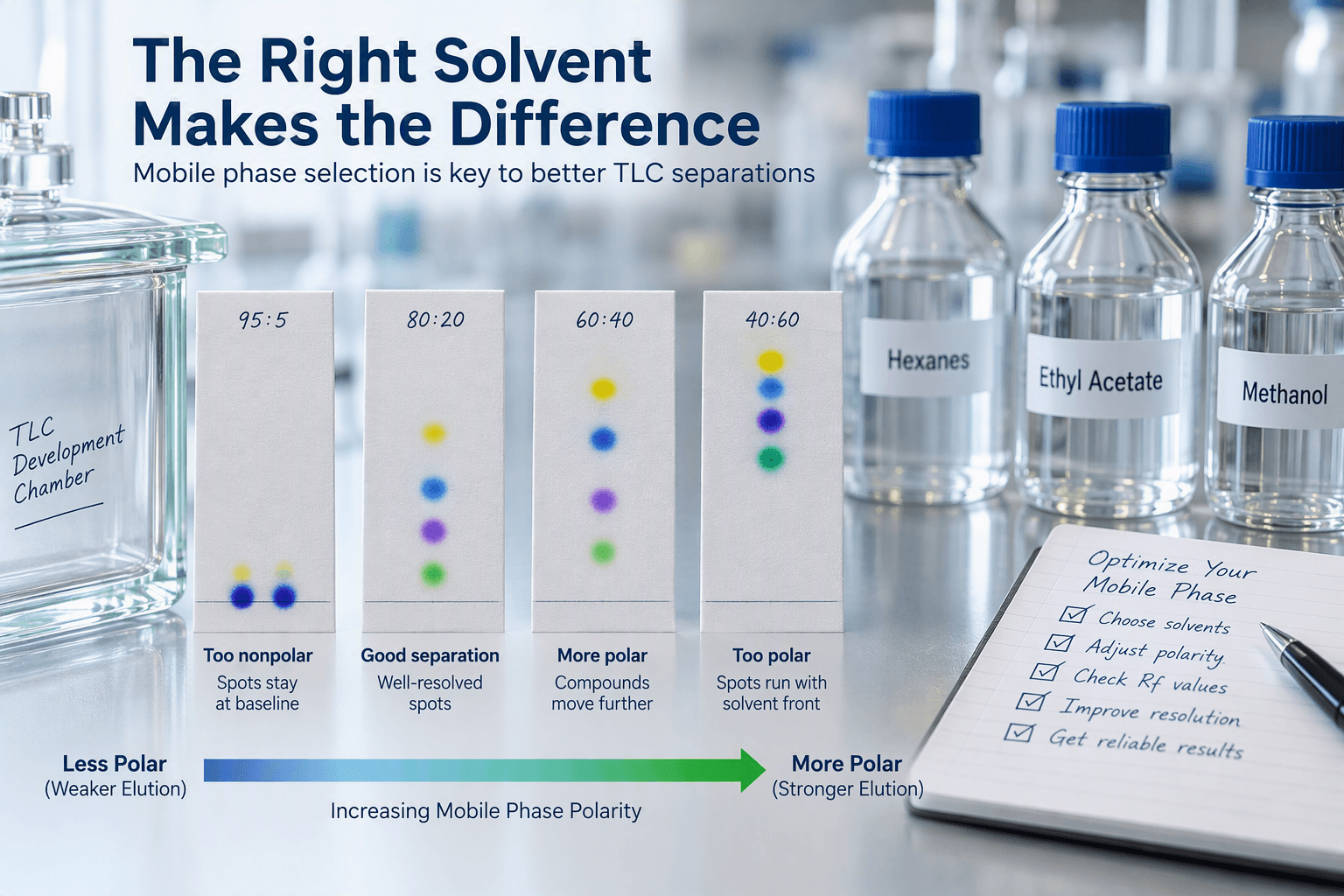
 Thin Layer Chromatography (TLC) is one of the most widely used analytical techniques in chemistry laboratories. It is fast, inexpensive, and highly effective for monitoring reactions, TLC method development, checking sample purity, and identifying compounds. While the stationary phase often receives significant attention, the mobile phase plays an equally important role in achieving successful separations.
In fact, choosing the right mobile phase is often the difference between a clear, useful chromatogram and a TLC plate that provides little meaningful information. Understanding how mobile phases work and how to optimize them can help chemists obtain sharper separations, faster analyses, and more reliable results.
What Is the Mobile Phase in TLC?
The mobile phase is the solvent, or mixture of solvents, that travels up the TLC plate by capillary action. As it moves through the stationary phase, typically silica gel or alumina, it carries the sample compounds along with it.
However, not all compounds move at the same rate. Their movement depends on the balance between:
- Attraction to the stationary phase
- Solubility in the mobile phase
- Molecular polarity
- Hydrogen bonding interactions
As a result, compounds separate into distinct spots as the solvent front advances up the plate.
Why Mobile Phase Selection Matters
The TLC mobile phase selection directly affects the retention factor (Rf) values of compounds. If the solvent is too weak, compounds remain near the origin and produce little separation. On the other hand, if the solvent is too strong, compounds move near the solvent front and may overlap.
An ideal mobile phase creates:
- Well-separated spots
- Compact spot shapes
- Reproducible Rf values
- Short development times
- Clear visualization of components
Therefore, solvent selection is often the most important variable to optimize during TLC method development.
Understanding Polarity in TLC
Most TLC applications use silica gel as the stationary phase. Silica is highly polar and strongly attracts polar compounds through hydrogen bonding and dipole interactions.
Because of this:
- Nonpolar compounds generally travel farther up the plate.
- Polar compounds tend to move more slowly.
- Increasing mobile phase polarity causes compounds to migrate farther.
This relationship is the foundation of TLC solvent selection.
For example, a nonpolar solvent such as hexanes has limited ability to compete with silica for polar analytes. Consequently, many compounds remain near the baseline. In contrast, a more polar solvent such as ethyl acetate can better disrupt interactions between compounds and the silica surface, allowing compounds to travel farther.
Common TLC Solvents
Several solvents are commonly used in TLC method development.
Nonpolar Solvents
These solvents provide weaker elution strength:
- Hexanes
- Heptane
- Cyclohexane
- Petroleum ether
- Toluene
Nonpolar solvents are often used for hydrocarbons, lipids, and other hydrophobic compounds.
Moderately Polar Solvents
These solvents are frequently used to fine-tune separations:
- Ethyl acetate
- Dichloromethane
- Chloroform
- Diethyl ether
Many organic compounds separate effectively within this polarity range.
Polar Solvents
These solvents provide stronger elution power:
- Acetone
- Acetonitrile
- Methanol
- Ethanol
- Water
Polar solvents are often added in small amounts to improve the movement of highly polar compounds.
Using Solvent Mixtures
Rarely does a single solvent provide the perfect separation. Instead, chemists commonly combine solvents to adjust polarity and optimize performance.
One of the most popular systems is:
Hexanes : Ethyl Acetate
Typical ratios include:
- 90:10
- 80:20
- 70:30
- 60:40
- 50:50
As the amount of ethyl acetate increases, compounds generally move farther up the plate.
Similarly, other popular solvent systems include:
- Dichloromethane : Methanol
- Toluene : Ethyl Acetate
- Hexanes : Acetone
- Chloroform : Methanol
By modifying solvent ratios incrementally, analysts can often achieve excellent separations with minimal trial and error.
A Practical Approach to Mobile Phase Development
Method development does not have to be complicated.
A common strategy is to begin with a moderately nonpolar solvent system and evaluate the resulting chromatogram.
If spots remain too close to the origin:
- Increase solvent polarity.
If spots move too close to the solvent front:
- Decrease solvent polarity.
The goal is usually to obtain Rf values between approximately 0.2 and 0.8 while maintaining sufficient separation between compounds.
Small solvent adjustments often have a significant impact on chromatography, especially when working with polar analytes.
Troubleshooting Common TLC Issues
Spots Stay at the Baseline
Possible causes include:
- Mobile phase is too nonpolar
- Sample is strongly retained by silica
- Inadequate solvent strength
Solution:
Increase solvent polarity by adding more polar components.
Spots Run with the Solvent Front
Possible causes include:
- Mobile phase is too polar
- Excessive solvent strength
Solution:
Reduce the proportion of polar solvent.
Poor Resolution Between Compounds
Possible causes include:
- Inappropriate solvent composition
- Similar compound polarities
Solution:
Optimize solvent ratios or test an alternative solvent system.
Streaking Spots
Possible causes include:
- Sample overload
- Strong sample-silica interactions
- Impurities in the sample
Solution:
Apply less sample and evaluate alternative solvent systems.
The Importance of Reproducibility
Consistent mobile phase preparation is essential for obtaining reproducible TLC results. Even small variations in solvent composition can change Rf values and affect interpretation.
For this reason, laboratories should:
- Measure solvent ratios carefully
- Use fresh solvents when possible
- Saturate development chambers consistently
- Document solvent compositions in detail
These practices improve method transferability and help ensure reliable analytical results.
Mobile Phase Selection and Preparative Chromatography
TLC is often used as a scouting tool before performing flash chromatography or preparative HPLC purification. The mobile phase developed during TLC experiments frequently provides valuable guidance for larger-scale separations.
A well-optimized TLC solvent system can help scientists:
- Predict chromatographic behavior
- Estimate separation difficulty
- Reduce purification development time
- Improve preparative chromatography efficiency
As a result, TLC remains an indispensable method development tool throughout analytical and purification workflows.
Final Thoughts
The mobile phase is one of the most important variables in Thin Layer Chromatography. By understanding solvent polarity, selecting appropriate solvent systems, and carefully optimizing solvent ratios, chemists can achieve faster, cleaner, and more reproducible separations.
Whether monitoring a reaction, evaluating product purity, or developing a purification method, proper mobile phase selection transforms TLC from a simple screening technique into a powerful analytical tool. Taking the time to optimize the mobile phase often yields clearer results, better resolution, and greater confidence in every chromatographic analysis.