


Introduction
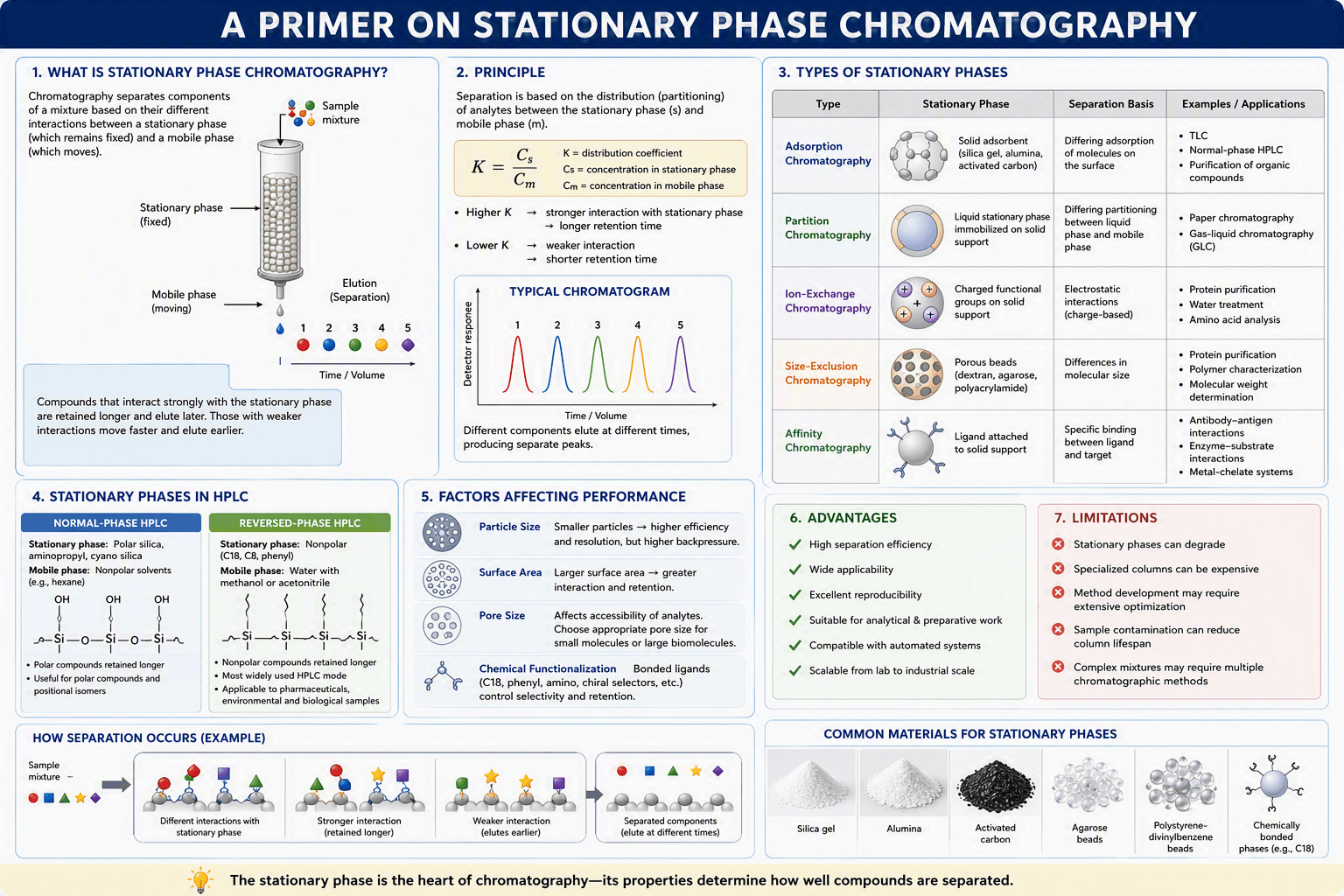
Stationary phase chromatography is a fundamental separation technique used in analytical chemistry, biochemistry, pharmaceuticals, environmental science, and industrial process control. Chromatography, in general, separates components of a mixture based on their differing interactions between two phases: a stationary phase, which remains fixed in place, and a mobile phase, which moves through or over the stationary phase. The stationary phase plays the critical role in determining how compounds are retained and separated.
The effectiveness of any chromatographic system depends largely on the properties of the stationary phase. By carefully selecting the stationary phase, scientists can separate molecules according to polarity, size, charge, hydrophobicity, or specific chemical interactions.
Principles of Stationary Phase Chromatography
In stationary phase chromatography, sample molecules distribute themselves between the stationary and mobile phases. Compounds that interact strongly with the stationary phase spend more time attached to it and therefore move more slowly. Compounds with weaker interactions remain primarily in the mobile phase and move faster through the system.
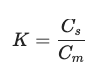
The separation mechanism can be described by the equilibrium:
 |
where: |
|
A higher value of K means the compound prefers the stationary phase and will be retained longer.
The differences in retention times among components create the separation observed in a chromatogram.
Types of Stationary Phases
1. Adsorption Chromatography
In adsorption chromatography, the stationary phase is a solid material, typically silica gel or alumina. Molecules are separated based on their ability to adsorb onto the surface of the solid.
Common stationary phases include:
- Silica gel (SiO₂)
- Alumina (Al₂O₃)
- Activated carbon
Polar compounds generally exhibit stronger interactions with polar stationary phases and therefore move more slowly.
Applications:
- Thin-layer chromatography (TLC)
- Normal-phase high-performance liquid chromatography (HPLC)
- Purification of organic compounds
2. Partition Chromatography
Partition chromatography uses a liquid stationary phase immobilized on a solid support. Separation occurs because compounds partition differently between the stationary liquid and the mobile phase.
Examples include:
- Paper chromatography
- Gas-liquid chromatography (GLC)
Compounds with greater solubility in the stationary liquid phase display longer retention.
3. Ion-Exchange Chromatography
Ion-exchange stationary phases contain charged functional groups attached to a solid support.
Examples:
| Type | Functional Group | Separates |
|---|---|---|
| Cation Exchange | Sulfonate (-SO₃⁻) | Positively charged ions |
| Anion Exchange | Quaternary amine (-NR₄⁺) | Negatively charged ions |
This technique is widely used for:
- Protein purification
- Water treatment
- Amino acid analysis
- Biotechnology applications
4. Size-Exclusion Chromatography
Also known as gel filtration or gel permeation chromatography, this technique separates molecules according to size.
The stationary phase consists of porous beads made from materials such as:
- Dextran
- Agarose
- Polyacrylamide
Large molecules bypass pore structures and elute first, while smaller molecules enter the pores and elute later.
Applications include:
- Protein purification
- Polymer characterization
- Molecular weight determination
5. Affinity Chromatography
Affinity chromatography employs highly specialized stationary phases containing ligands that selectively bind target molecules.
Examples include:
- Antibody-antigen interactions
- Enzyme-substrate interactions
- Metal-chelate binding systems
Because of its high selectivity, affinity chromatography is one of the most powerful purification methods available for biomolecules.
Stationary Phases in HPLC
High-performance liquid chromatography (HPLC) is among the most common analytical techniques and relies heavily on stationary phase selection.
Normal-Phase HPLC
Stationary phase:
- Polar silica
- Aminopropyl silica
- Cyano silica
Mobile phase:
- Nonpolar solvents such as hexane
Characteristics:
- Polar compounds are retained longer.
- Useful for separating positional isomers and polar compounds.
Reversed-Phase HPLC
Stationary phase:
- C18 (octadecylsilane)
- C8 (octylsilane)
- Phenyl columns
Mobile phase:
- Water mixed with methanol or acetonitrile
Characteristics:
- Nonpolar compounds are retained longer.
- Most widely used form of HPLC.
- Applicable to pharmaceuticals, environmental samples, and biological materials.
The C18 column is considered the industry standard because of its versatility and reproducibility.
Factors Affecting Stationary Phase Performance
Several parameters influence chromatographic performance:
Particle Size
Smaller stationary phase particles provide:
- Increased surface area
- Better resolution
- Higher efficiency
However, they also generate higher system backpressure.
Surface Area
A larger surface area increases analyte interaction and retention capacity, improving separation effectiveness.
Pore Size
Pore size is especially important for proteins and macromolecules.
- Small pores suit small molecules.
- Large pores are required for peptides and proteins.
Chemical Functionalization
Modern stationary phases often contain bonded ligands that tailor selectivity.
Examples include:
- C18 chains
- Phenyl groups
- Amino groups
- Chiral selectors
These modifications allow separation of highly similar compounds.
Advantages of Stationary Phase Chromatography
Key benefits include:
- High separation efficiency
- Wide applicability across chemical classes
- Excellent reproducibility
- Capability for both analytical and preparative work
- Compatibility with automated instrumentation
- Scalability from laboratory to industrial production
These advantages make chromatography indispensable in modern science and manufacturing.
Limitations
Despite its utility, stationary phase chromatography has some limitations:
- Stationary phases can degrade over time.
- Specialized columns can be expensive.
- Method development may require extensive optimization.
- Sample contamination can reduce column lifespan.
- Complex mixtures may require multiple chromatographic methods.
Proper column maintenance and method validation are essential for obtaining reliable results.
Conclusion
Stationary phase chromatography is the foundation of modern chromatographic separation techniques. The stationary phase governs analyte retention and selectivity through interactions such as adsorption, partitioning, ion exchange, size exclusion, and affinity binding. Advances in stationary phase design have dramatically improved resolution, sensitivity, and speed, enabling applications ranging from pharmaceutical quality control and environmental monitoring to biotechnology and proteomics. Understanding the characteristics and selection of stationary phases is therefore critical for developing effective chromatographic methods and achieving high-quality analytical results.
Be first in line for the upcoming Stationary Phase Handbook.
Created by the experts at Sorbtech, this comprehensive resource will cover key stationary phase concepts, selection strategies, and practical application tips.
Reserve your complimentary copy today and receive an exclusive notification when the handbook is released.