


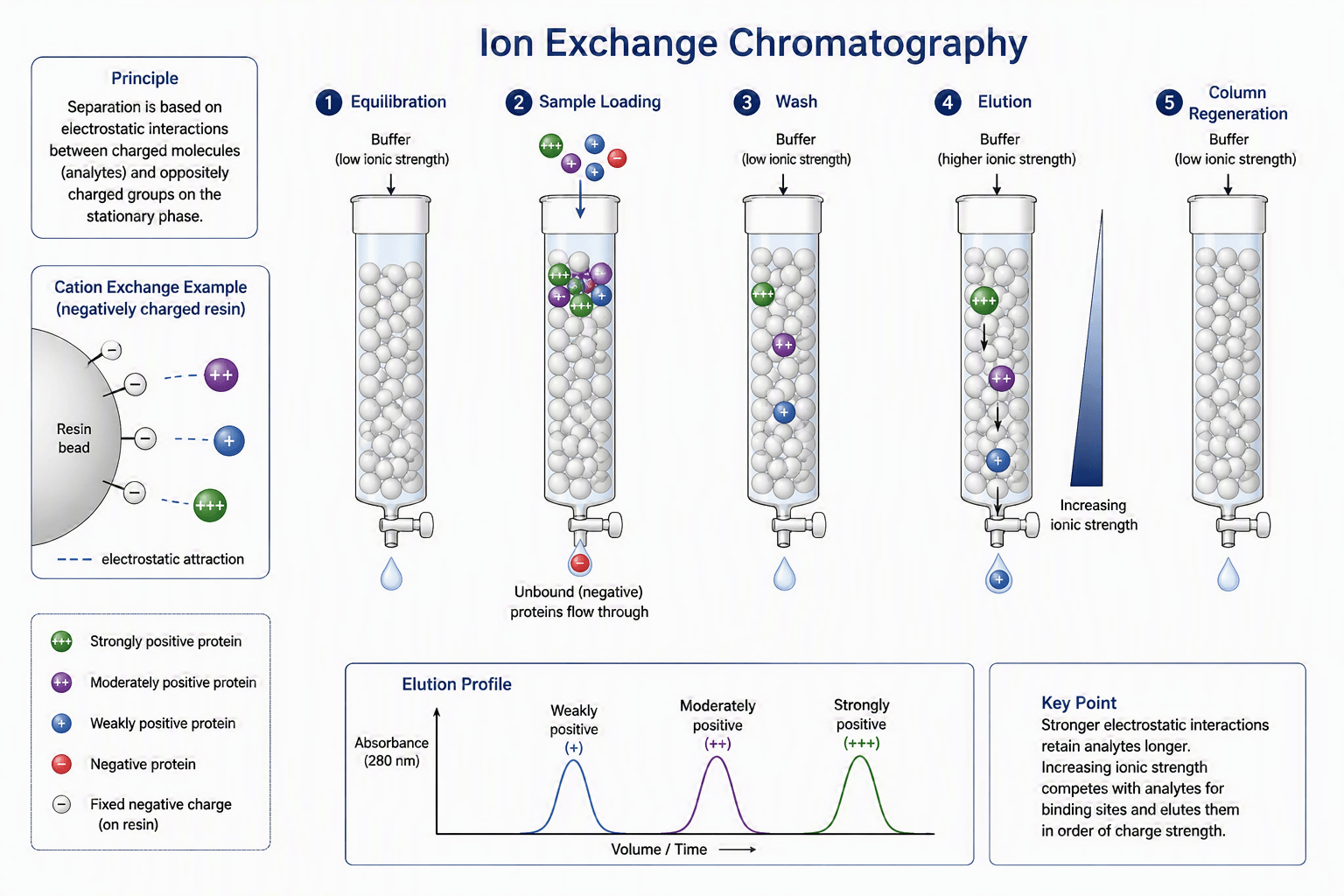
Ion-exchange chromatography (IEC) is a highly effective separation method that separates molecules based on their overall surface charge. As a result, scientists widely use it in biochemistry, pharmaceutical manufacturing, and purification processes for proteins, peptides, nucleic acids, and small ions.
Core Principle
IEC works through reversible electrical attractions between charged molecules and an oppositely charged stationary phase, known as the ion exchanger. Typically, the stationary phase contains silica or polymer beads coated with charged chemical groups. Depending on the type of charge, the resin can function as either a cation or anion exchanger:
- Cation exchangers contain negatively charged groups, such as sulfonic acid or carboxylic acid. Therefore, they attract and hold positively charged molecules.
- Anion exchangers contain positively charged groups, such as quaternary ammonium groups. Consequently, they attract and hold negatively charged molecules.
How IEC Works
The ion-exchange process follows several key steps:
-
Sample Loading
First, operators introduce the sample mixture into the column. Under the right conditions, target molecules attach to the resin, while other components pass through the column. -
Washing
Next, a low-salt buffer washes away unbound or weakly attached impurities, helping improve the purity of the target molecules. -
Elution
Then, operators release the bound molecules by increasing the salt concentration or adjusting the pH. In the first approach, competing ions displace the target molecules. In the second, changes in pH alter the charge of the molecules or the resin, reducing their attraction. -
Regeneration
Finally, operators clean and re-equilibrate the column so it is ready for another separation cycle.
Factors That Influence Separation
Several factors affect IEC performance. For example, pH determines the charge of the molecules, while ionic strength influences the strength of ionic interactions. In addition, flow rate affects contact time within the column, and resin selectivity determines how strongly different molecules bind. Strong and weak ion exchangers can also produce different separation results.
Sorbtech Connection
Sorbtech provides a range of chromatography solutions that support ion-exchange and related purification needs. For ion-exchange media and related adsorbents, explore our full selection here: Chromatography Products.