


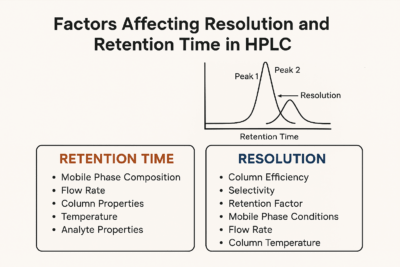
 In High-Performance Liquid Chromatography (HPLC), resolution (how well two peaks are separated) and retention time (how long a compound takes to elute) are influenced by several interrelated factors. These can be grouped into column properties, mobile phase conditions, instrumental parameters, and analyte characteristics.
✅ Factors Affecting Retention Time (tR)
Retention time depends mainly on how strongly an analyte interacts with the stationary phase vs. the mobile phase.
1. Mobile Phase Composition
- Polarity (in reversed-phase HPLC):
- More organic solvent (e.g., acetonitrile, methanol) → shorter retention time
- More aqueous phase → longer retention time
- pH:
- Affects ionization of analytes → changes interaction with column → alters retention
- Buffer strength:
- Stabilizes pH and can influence retention consistency
2. Flow Rate
- Higher flow rate → decreases retention time
- Lower flow rate → increases retention time
- Note: Very high flow can reduce separation quality
3. Column Properties
- Column length: Longer column → longer retention time
- Particle size: Smaller particles increase interaction → slightly longer retention
- Stationary phase chemistry (e.g., C18, C8): Stronger hydrophobic phase → longer retention for nonpolar compounds
4. Temperature
- Higher temperature → faster mass transfer → shorter retention time
- Can also change selectivity slightly
5. Analyte Properties
- Polarity: Nonpolar compounds (in reversed-phase) → longer retention
- Molecular size and functional groups: Affect interaction with stationary phase
✅ Factors Affecting Resolution (Rs)
Resolution describes how well two peaks are separated and depends on three main parameters:
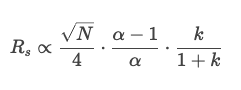
Where:
- N = efficiency (number of theoretical plates)
- α = selectivity
- k = retention factor
1. Column Efficiency (N)
- Improved by:
- Smaller particle size
- Longer column length
- Proper packing
- Higher efficiency → narrower peaks → better resolution
2. Selectivity (α)
- Most powerful factor for improving resolution
- Affected by:
- Mobile phase composition
- pH changes
- Stationary phase type
- Even small changes in selectivity can greatly improve separation
3. Retention Factor (k)
- Ideally between 2–10
- Too low → poor separation (peaks overlap)
- Too high → long analysis time with little improvement
4. Mobile Phase Conditions
- Solvent strength and type
- pH and ionic strength
- Gradient vs. isocratic elution
5. Flow Rate
- There is an optimal flow rate (van Deemter equation)
- Too fast or too slow → band broadening → reduced resolution
6. Column Temperature
- Influences viscosity and mass transfer
- Can improve peak shape and resolution
7. Extra-Column Effects
- Tubing length/diameter
- Detector cell volume
- Injector dispersion
→ These can cause peak broadening and reduce resolution
🔹 Summary Table
| Factor | Effect on Retention Time | Effect on Resolution |
|---|---|---|
| Mobile phase strength | ↓ with more organic solvent | Strong impact via selectivity |
| Flow rate | ↓ when increased | Optimal value required |
| Column length | ↑ | ↑ (better separation) |
| Particle size | Slight ↑ | ↑ (better efficiency) |
| Temperature | ↓ | Can improve |
| pH | Alters | Strong influence |
| Stationary phase | Alters | Major effect |
🧠 Key Takeaway
- Retention time is mainly controlled by mobile phase strength, flow rate, and analyte chemistry.
- Resolution depends on efficiency (N), selectivity (α), and retention factor (k), with selectivity being the most critical.