


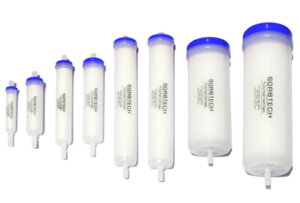
 Flash chromatography is a fast and effective way to purify organic compounds. It works on the same principles as traditional column chromatography, but it uses pressurized solvents to speed up separations. As a result, it has become especially valuable when time and efficiency are critical.
Key Factors for Optimization
1. Solvent System
The solvent system plays one of the biggest roles in separation quality. Instead of relying on a single solvent, you can adjust polarity by mixing different ones. For example, a hexanes and ethyl acetate blend works well to separate compounds with different polarities. Choosing the right balance of polarity and solubility is essential for isolating your target compound.
2. Column Choice
The type of column also matters. Flash columns are usually made of glass or plastic and packed with stationary phases like silica gel or alumina. When separating polar molecules, silica gel is often the better choice. On the other hand, alumina frequently performs better for nonpolar compounds. Therefore, matching the stationary phase to your sample saves both time and solvent.
3. Flow Rate
Flow rate directly affects both speed and resolution. Increasing the rate shortens run time, yet it can also reduce resolution. On the flip side, lowering the rate improves resolution but requires more time. Striking the right balance helps ensure efficiency without sacrificing quality.
4. Temperature
Temperature is another factor that influences separation. Raising it often accelerates elution; however, heat-sensitive compounds may degrade. Thus, it is always best to select a temperature that maximizes performance while keeping your compounds stable.
Practical Tips for Better Results
-
Always pack the column carefully to avoid band broadening.
-
In addition, use a pre-column to filter samples and solvents, which reduces clogging and contamination.
-
Monitoring separations with TLC, UV detection, or other tools allows you to track progress in real time.
-
Collect fractions at steady intervals so you do not lose part of the target compound.
-
Finally, evaporate solvents and confirm purity using TLC, melting point checks, or NMR spectroscopy.
Common Applications
-
Enantiomer separation: By using chiral columns with a chiral selector, you can efficiently resolve mirror-image molecules.
-
Natural products: Complex mixtures such as alkaloids or terpenes can be separated quickly and reliably.
-
Synthetic compounds: As the final purification step in multi-step syntheses, flash chromatography removes impurities and improves purity.
Final Thoughts
Flash chromatography remains one of the most versatile and powerful purification techniques in modern labs. When you carefully optimize the solvent system, column type, flow rate, and temperature, you gain faster separations, higher purity, and better yields. With these strategies, you can turn a challenging purification into a reliable, reproducible process.

About the Author – Randy Cooper, MBA PCM
Randy Cooper brings more than 35 years of experience in marketing technology. He earned his Bachelor of Science in Information Technology with a concentration in web development from the University of Phoenix and later completed his MBA in Digital Marketing at Liberty University. In addition, he holds the Professional Certified Marketer (PCM) credential from the American Marketing Association.
In 2009, Randy launched Buzz My Biz, a technology consulting agency dedicated to delivering enterprise-level solutions to small and mid-sized businesses. Since then, he has helped organizations grow by combining digital strategy, marketing expertise, and technical innovation.
When he steps away from the keyboard, Randy enjoys cheering on the Atlanta Braves, spending time outdoors hiking, and working in his yard.