


Background
When examining silica gel comparisons, several key chromatographic parameters should always be considered. These include the retention factor (k), selectivity (α), and efficiency (N). Together, these factors determine the overall peak resolution (Rs). While the exact values may change depending on the compound being tested, the separation of acetophenone and 4-methoxyacetophenone is a well-documented example often used to illustrate these principles.
Definitions
Retention Factor (k) – This value shows how strongly a compound interacts with the silica. A larger k means the compound spends more time bound to the stationary phase before eluting.
Selectivity (α) – Selectivity measures how well the system can tell two compounds apart. A higher α value means better separation. If α equals 1, the compounds co-elute and cannot be separated.
Efficiency (N) – Efficiency, often called the theoretical plate number, reflects how sharp or broad a peak appears. A higher N indicates narrower peaks and a more efficient column.
Resolution (Rs) – Resolution combines retention factor, selectivity, and efficiency to describe how well two peaks are separated. A higher Rs value means cleaner, more reliable separations.
Practical Examples
The chromatograms below were generated using a 40-gram chromatography column packed with the chosen media. During both the equilibration step and the separation, the flow rate was held constant at 30 mL/min.
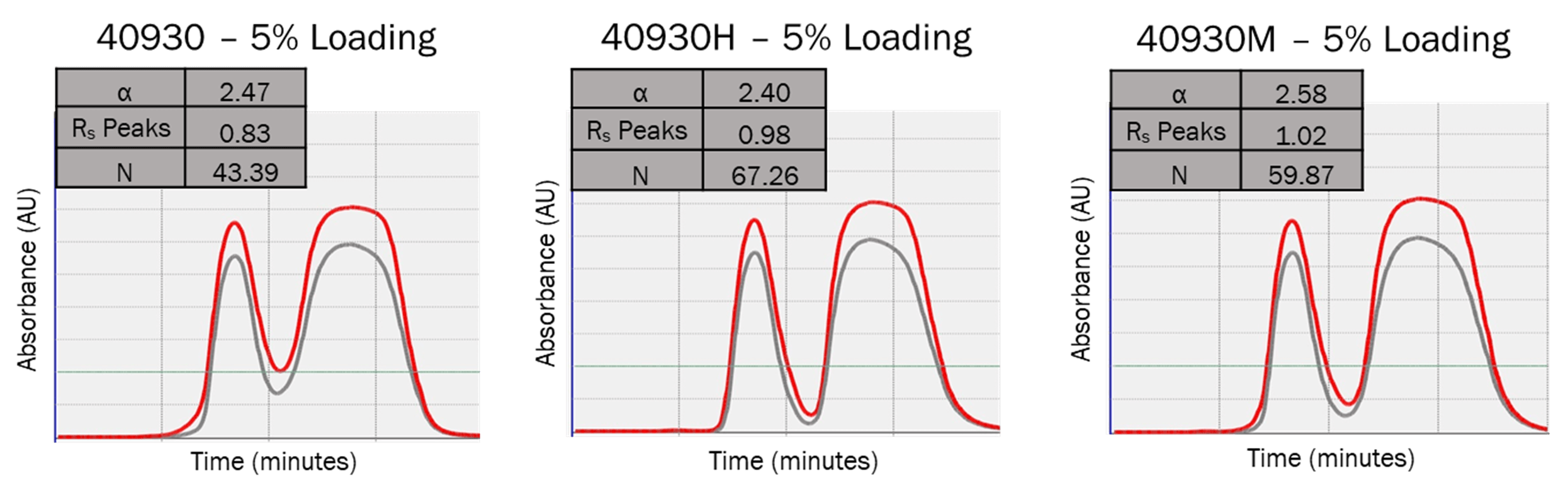
The test mixture contained acetophenone (100 mg/mL) and 4′-methoxyacetophenone (100 mg/mL), giving a total concentration of 200 mg/mL. For the 1% loading test, 2 mL of this mixture—equal to 400 mg—was applied to the column. In contrast, for the 5% loading test, 10 mL of the mixture—equal to 2 g—was loaded.
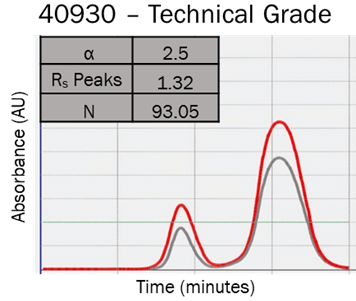
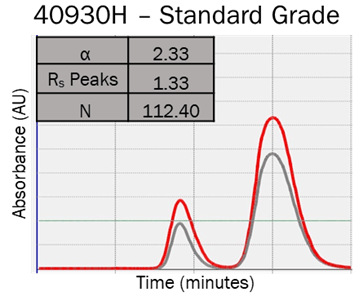
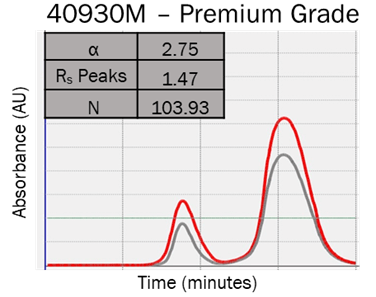
Silica Gel Comparisons: Technical, Standard, and Enhanced Grades
When reviewing silica gel comparisons across Technical, Standard, and Enhanced grades, clear differences emerge in selectivity, resolution, and efficiency—even if the chromatograms look similar. The Enhanced grade delivers the best selectivity and resolution, though it sacrifices some column efficiency. This lower efficiency results from its reduced water content, which affects packing. In contrast, the Standard grade (40930H) shows stronger efficiency than the Technical grade. As expected, the Technical grade performs the weakest overall because of its broader product specifications.
Performance at Higher Loading
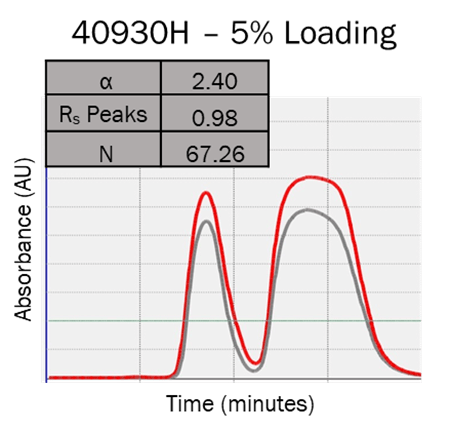
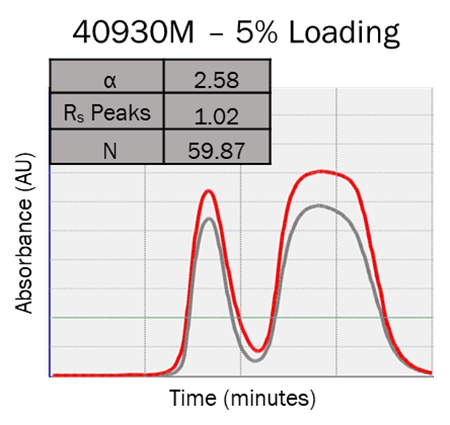
At higher loading levels, the Standard and Enhanced grades both outperform the Technical grade by a wide margin. On the 40930 Technical material, peaks fail to separate, while both the 40930H and 40930M nearly reach baseline resolution. Between the two, the Standard grade (40930H) achieves greater efficiency, while the Enhanced grade (40930M) offers superior selectivity.
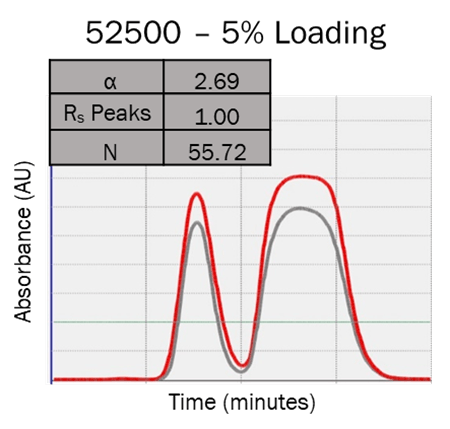
When better separations are required, higher-grade options are available. These silicas are produced under very strict standards and contain the lowest trace metal levels of all Sorbtech granular silicas. For example, when comparing the 52500 to the 52300, you see a clear boost in selectivity, peak resolution, and overall column efficiency. Furthermore, when both are compared to the 40930 and 40930M materials, every parameter shows noticeable improvement.
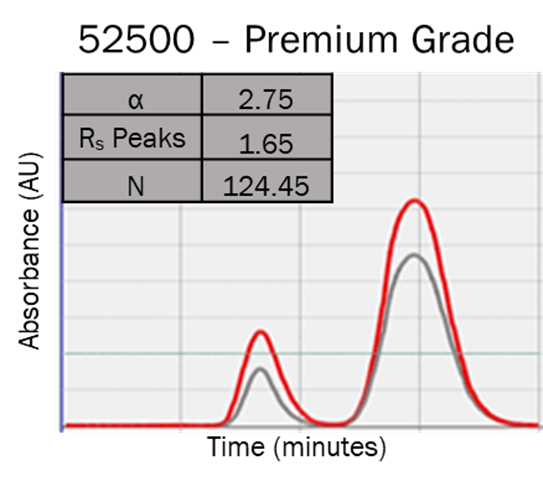
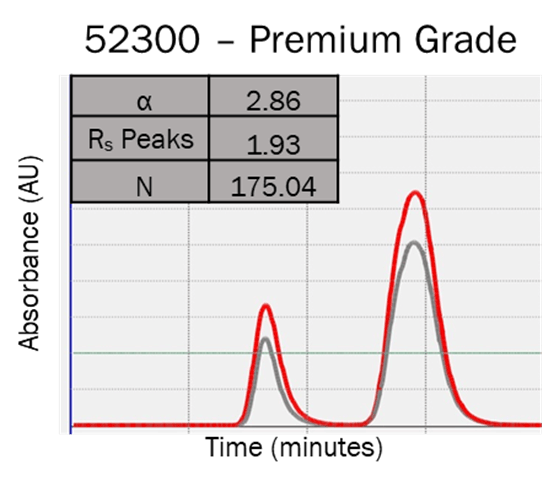
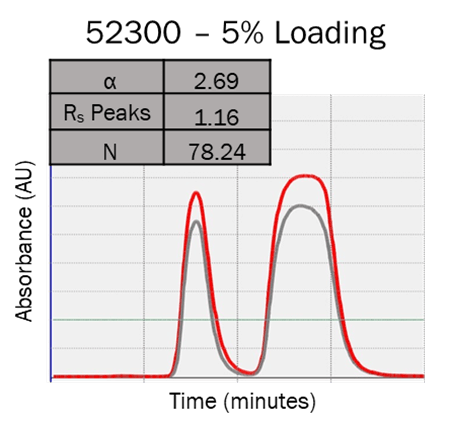
Loading studies highlight the key differences between the 52500 Premium grade and the 52300 Premium grade silicas. Although both offer identical selectivity, the smaller particle size of the 52300 delivers much higher resolution and efficiency. This improved efficiency produces significantly narrower peaks. In contrast, the 52500 shows two peaks that never fully separate, while the 52300 achieves complete separation. Moreover, when either Premium grade (52500 or 52300) is compared to the 40930H or 40930M, all performance parameters improve, resulting in superior separations.
Performance of the 40930 Series
Most separations run well on the 40930 series. However, the 40930H proves to be the stronger option when you need higher efficiency, sharper peak resolution, and better loading capacity. The 40930M stands out as the best choice within the series. Because it contains the lowest water content, it delivers the highest selectivity and resolution of the three.
Advantages of Premium Grades (52500 and 52300)
For large-scale or pharmaceutical separations, the 52500 and 52300 grades remain unmatched. These premium silicas contain fewer trace metals and feature a much narrower particle size distribution. As a result, they consistently deliver superior selectivity, resolution, and efficiency.
High-Loading Benefits of 52300
When high loading is required, the 52300 outperforms others. Even at 5% loading, it still achieves baseline separation, making it the preferred choice for demanding workflows and critical applications.